I read a lot of academic articles about school counseling in my current role as a doctoral student in counselor education. Recently I was reading an article that critiqued school counselors who unintentionally limited student options through college and career conversations just focused on jobs and "threaded with an anxiety about the future." Although I found most of the article to be missing an understanding of school counseling as a profession, I did like the author's vision for facilitating conversations about the future and postsecondary education.
Tieken (2016) suggested we "must ask not just What do you want to be? but also Who do you want
to be? Where do you want to be? Why and how do you want to be? and, importantly, How can
we support you?" (p. 220).
What powerful questions to guide all of us working with students and clients! I believe these questions are in the spirit of what we do as school counselors.
Friday, October 21, 2016

Tuesday, November 17, 2015
Playing at School
In October I attended the Association for Play Therapy conference in Atlanta. I love play therapy and believe it is a powerful tool for elementary school counselors to use in responsive services. Child-Centered Play Therapy (CCPT) was the approach I learned in graduate school and that I practice from. I often used play therapy as an individual counseling modality with students, and I used group play therapy when conducting social skills groups with K-1st graders. I've heard from other school counselors that having the time, space, or training to use play therapy make it challenging for them to implement. I also believe one of the blocks to using play therapy in the schools is a misunderstanding from other educators of what it is and why it works. In my experience, the idea of letting a child (who was often getting in trouble in the classroom) come to play with me was difficult for other educators to grasp! But I have experienced the power of therapeutic play for children and want other school counselors to use this approach as well.

Here is some of the information that I shared at my poster presentation at the APT conference that offers research and evidence-based support for using play therapy in school settings.
Play Therapy Improves Social Functioning:
Play Therapy Improves Academic Functioning:
“Play therapy, therefore, is an adjunct to the learning environment, an experience that helps children maximize opportunities to learn in the classroom” (Landreth, 2012, p. 86)

Here is some of the information that I shared at my poster presentation at the APT conference that offers research and evidence-based support for using play therapy in school settings.
Play Therapy Improves Social Functioning:
- CCPT helps children develop behaviors that benefit self and others
- Evidence of changes in self-esteem, self-concept, and self-control after CCPT
- Evidence of differences in externalizing problems (aggressive, hyperactive, or rule-breaking behaviors) for children who do and do not participate in play therapy (e.g. Flahive & Ray, 2007; Ray, Armstrong, Balkin & Jayne, 2015; Post, 1999;)
- Changes in social functioning and behaviors after play therapy for children with disabilities (autism, ADHD, developmental disabilities, intellectual disabilities)
Play Therapy Improves Academic Functioning:
- Studies linking participation in CCPT with academic achievement for at-risk children (e.g. Blanco & Ray, 2011; Blanco, Ray, & Holliman, 2012)
- Academic functioning may be improved through increased self-confidence and coping skills as well as increases in intrinsic motivation from CCPT
Implications for School Play Therapists:
- Build awareness of benefits and uses of play therapy for teachers, administrators, and stakeholders
- Provide Child Teacher Relationship Training to help teachers understand needs of students and respond to behavior problems
- Collaborate with special education teachers and staff for play interventions serving students with disabilities
“Play therapy, therefore, is an adjunct to the learning environment, an experience that helps children maximize opportunities to learn in the classroom” (Landreth, 2012, p. 86)
This link connects to my list of references for the presentation and further information about using play therapy in school settings.
Monday, September 21, 2015
Adolescent Grief Resources
This past weekend I had the opportunity to spent two days with middle and high school teens at a children's bereavement camp. I served as a clinical group leader and planned activities and facilitated group sessions in the midst of ropes courses and arts and rappelling. It was a powerful weekend for seeing the resiliency and courage of kids who have experienced a significant death loss. In my planning, I found several resources to share with school counselors.

Safe Crossing's Children's Grief Program has a guide specifically for school counselors that has been a go-to resource for me since finding it online years ago. This link takes you to the guide.
The Behavioral & Emotional Grief Response Card Sort (pages 8-10 in the guide above) is a powerful activity that I have used in elementary settings with students 4th grade and up. I have students sort thoughts/feelings/behaviors they have and have not experienced since the death loss. For group processing with middle or high schoolers, pass cards around the group and have students make a dot on each card that matches their personal experience. Then ask students to share which cards have the most dots. Questions for processing this activity can include:
- Which cards have the most dots? (For the “just want to die too” card, be sure to talk about this and steps they need to take if considering acting on this pain or wish to be with the person)
- What do you do when you feel that way?
- What was surprising about the list of feelings or behaviors?
- What was it like seeing so many dots on these cards?
- Who in your life understands these feelings and thoughts? who are you talking about this with?
Another activity that can be used for individual or group processing is Skittles & Grief. I found a list of sentence stems on Pinterest and adapted them into this activity. Pass out Skittles fun packs and a half sheet of this handout. If using it in a group, have members get with a partner and share responses based on at least 3 skittles colors they pull out of the pack. Ask students to elaborate on their response or model partners asking for more details.

An art activity that can be used for individual or group counseling is altered books (also called art journals). I found hardback books at Goodwill that were appropriate for use with teens and had supplies (glue sticks, paper for collaging, and gesso and paint brushes for washing out words) to have group members begin their journal for their own story. This link gives some helpful hints on creating altered books. I also found guides on youtube and pinterest that were helpful in my planning.
This guidebook has great information for caregivers on developmental grief responses and resources for supporting children and adolescents as they grieve.
Have other favorite activities or resources that have worked well with adolescents? Share them in the comments!
Wednesday, September 10, 2014
It's Been Awhile . . .
Somewhere in the craziness of last school year and life transitions, this blog was neglected. And right now life is a little different for me. I am no longer working in a school but have moved to Knoxville, TN where I am pursing a PhD in Counselor Education at the University of Tennessee. I read this interview with Julia V. Taylor earlier this week on pursing a doctorate as a school counselor and thought it was a great summary and perspective that I can relate to right now!
I do still want to update this blog with ideas as I have so many things I'd love to share with you! So please continue to check back here.
I know that there were numerous recap posts this summer after the ASCA conference in Orlando. (I tweeted from the conference if you want to check back some thoughts while there.) But I have continued to be inspired by the amazing work happening within our field and honestly have missed being in a school to implement ideas I heard about. I recently re-watched Michelle Obama's message from ASCA and was excited once again about the work happening with students every day to help them reach higher. I hope this school year is starting off well for you!
Wednesday, February 26, 2014
Technology for the Win!
I presented a breakout session earlier this week at the TN School Counselor Leadership Institute called "Technology for the Win!" targeted for elementary school counselors.

This is a copy of the handout that I gave out to a packed room! I also shared that I'd be uploading some lessons in Notebook onto SMART exchange for download. This should be the link to files I've uploaded onto this site. Will continue to add things to exchange so check back!
TN School Counselor & Leadership Institute Recap
I attended the TN School Counselor & Leadership Institute in Chattanooga earlier this week. It's always so energizing for me to be around other school counselors and educators and to see their passion for what they do for kids each day. Knowing that most of us are the only counselor in our building, I believe it is so important for us to connect with and learn from others. A few highlights that I'm continuing to think about as I return to my school this week . . .
Behavior Interventions that Work - Amie Dean
www.behaviorqueen.com
One of the best professional learning sessions I've been to in a long time. I love how she framed the purposes of behavior. She stated that all behavior traces back to trying to get or get out of something - to get attention, control, power, or revenge and get out of work, pain, embarrassment, or lack of confidence. She set up the foundation for successful behavior as kids needing to know where they stand, that the teacher will follow through, and that the teacher is on their side. She also shared lots of behavior intervention resources that I'm glad to have in my toolbox now.
Building Strong(er) Working Relationships - Rodger Dinwiddle & Teresa Whitaker
www.starsnashville.org
I've been to enough of Rodger's sessions now over the years that when I see his name as a presenter, I go! This session talked about school climate through healthy working relationships and working out conflicts. The presenters discussed their 24 hours to work it out office norm and the power of having crucial conversations. Some concepts I'll continue to mull over. They also referenced this video that I love on vulnerability.
Unlearning Helplessness - Motivating the Underachiever - Julia Cook
www.juliacookonline.com
Julia Cook's books are staples in my guidance curriculum. She is a dynamic speaker, and she read 3 of her books to us in the course of the session which I loved. She also talked about underachieving students being those who have a significant gap in their ability verses what they achieve at school. This can be the gifted student not reaching full potential to the student about to drop out. In order to achieve, students need to feel connected, to feel confident in their abilities, to have fun, to make choices, and to feel safe. I like this recipe for achievement and the emphasis on relationships as a foundation for achievement!
I also presented a session on technology for elementary school counselors that I'll be posting about soon!
Wednesday, February 19, 2014
Conflict Resolution Jeopardy
Just a quick link today with a Conflict Resolution Jeopardy game I found online (and edited the answers to make it work for me.) I'm using this in upper grades as a review game to see how well students can think through ways to handle conflict situations.

You can play this game using this link. The website https://jeopardylabs.com/ is an easy way to build your own Jeopardy board to play review games.
Thursday, February 13, 2014
A Bug and a Wish
As we've been learning some ways to control our anger in 1st grade, we've talked about making good choices and cooling off first. To help students learn appropriate ways to talk to someone when they're having a problem, we learned about using "a bug and a wish." We role played various scenarios like this:
"It bugs me when you cut in line. I wish you would let me have my spot back."
"It bugs me when you take my pencil without asking. I wish you would give it back."
"It bugs me when you make fun of me. I wish you would stop."
Students were taught that the appropriate response is "Thank you for telling me. I will _____________." Hopefully this will fix the problem.
If the person they tell their bug and a wish to is not willing to cooperate, then they need to walk away or ask for help from an adult.
Students loved making bug and a wish talking sticks! They did a great job role playing with friends how they were going to use them.


Monday, February 10, 2014
7 Habits in 4th Grade
This year we've learned about the 7 Habits during 4th Grade Guidance Lessons. I spent a week focusing on each habit and incorporated a discussion of the habit along with a video clip and a story each week. I pulled ideas from other resources and Pinterest boards but wanted to share my compilation of resources that I used to make it work for my program. I used habit descriptions found on the Leader in Me website.
 Habit 1: Be Proactive
After a discussion of what a habit is and some good habits we already have, we learned about what it means to be proactive and take initiative. We discussed the video clip below. We discussed the difference between proactive and reactive responses with a volunteer shaking a soda bottle or water bottle to illustrate our different responses. We read Salt in His Shoes and discussed ways Michael Jordan was proactive even when things like his height and what other kids said to him were outside of his circle of control.
Habit 2: Begin with the End in Mind
We discussed what this trait means and watched a Kid President pep talk clip. We used this video as a springboard to discuss what is meant by rocks and thorns - obstacles that try to keep us from reaching our goals. We spent time talking about how we can reach our goals. We read a Readers Theater about Nelson Mandela and his goal to end apartheid and how he didn't give up on his goal even when imprisoned for so long. Students completed an activity sheet outlining some of their personal goals and steps they could take to reach them.
Habit 3: Put First Things First
We discussed this habit and how we know what is the most important thing we need to accomplish. We talked about time management and how that helps us prioritize. We read Greatest Homework Excuse Book Ever and discussed how we sometimes use excuses rather than just getting our work finished. We watched a video clip about Rocks in a Jar and discussed why we have to put the big rocks (our priorities) in first. Students completed an activity sheet where they labeled rocks in a jar to indicate personal priorities and then identified other things that they can spend time on after those priorities are met.
Habit 4: Think Win-Win
We learned what it means to think win-win and the importance of working out conflicts. We discussed a situation and identified responses as win-win (both people win), win-lose (you win, but the relationship doesn't), or lose-win (you give in but feel like a doormat). We watched a video clip of the Pixar One Man Band and discussed the moments in this clip when we saw (almost) win-win, win-lose, or lose-lose behaviors. Students also completed an activity sheet with scenarios and they had to determine how it demonstrated a win-win solution.
Habit 5: Seek First to Understand, Then to Be Understood
With this habit we discussed ways to show we're trying to really listen to someone so they can listen to us. We talked about roadblocks to good listening - spacing out, pretend listening, selective listening, and selfish listening. We watched a video clip from Toy Story and discussed the poor listening skills seen from the other toys. We talked about how this habit is really about being able to look at things from various viewpoints as a way to understand others. We read parts of the book Pink and Say as an example of characters understanding someone who was different from them.
Habit 6: Synergize
We discussed what this habit means and why teamwork is important. We watched two video clips of synergizing and discussed ways we saw synergy and how it helped those in the video be successful. We read a Reader's Theater story of the Montgomery Bus Boycott which lead to a discussion of how synergy helped the Civil Rights leaders accomplish their goals. Students also wrote a letter to our principal identifying a problem they've observed at our school and ways they could use synergy to solve the problem.
Habit 7: Sharpen the Saw
After a review of the first 6 habits, we finished our discussion with what it means to sharpen the saw and have balance. We compiled a list of ways we sharpen our mind, heart, soul, and body. We watched a video clip from Soul Pancake and then identified activities shown in the video that could help you balance each part of your life. Students did an activity sheet where they identified personal ways they're working to have balance in each area of their lives. We finished our time watching Jannah Bolin's 7 Habits song which the students loved!
Friday, February 7, 2014
Keep Counseling.
Happy National School Counseling Week! I'm so proud to be a part of this profession dedicated to helping students succeed academically while supporting their social and emotional development. I received this note from a student at the holidays and thought this week was a perfect time to share. Little reminders that what you're doing makes a difference are needed some days!


Thursday, December 12, 2013
Christmas Career Lessons
Just in time for the holidays, I'm doing lessons in each grade level incorporating Christmas activities and a career focus. I have seen many of these ideas on other blogs and Pinterest, but here is how I've incorporated them! I love building upon the magic of the season.
Kindergarten: We read How Santa Got His Elves and applied to be Christmas elves! They were so excited to have elf finger prints (a non-toxic kid stamp pad!) One student told me he was going to leave his application out with the milk and cookies for Santa to see if he could get the job.

1st Grade: We read Snowmen at Work and illustrated our snowmen to fit with a career we'd want to have. Each student then displayed their snowman on the projector and had their friends guess what career it was - we talked about the tools and outfits to include as evidence for their chosen career.

2nd Grade: We read How Santa Got His Job and talked about strengths that help us be good at our job. Students filled out a Substitute Santa application.

3rd and 4th Grade: We had a discussion about how one finds a career and descriptive adjectives that we would want an employer to know about us if we were an applicant. We applied to be one of Santa's reindeer.

5th Grade: We talked about the job search process and students worked together to create a classified section of a newspaper looking for various Christmas jobs.
Kindergarten: We read How Santa Got His Elves and applied to be Christmas elves! They were so excited to have elf finger prints (a non-toxic kid stamp pad!) One student told me he was going to leave his application out with the milk and cookies for Santa to see if he could get the job.
1st Grade: We read Snowmen at Work and illustrated our snowmen to fit with a career we'd want to have. Each student then displayed their snowman on the projector and had their friends guess what career it was - we talked about the tools and outfits to include as evidence for their chosen career.
2nd Grade: We read How Santa Got His Job and talked about strengths that help us be good at our job. Students filled out a Substitute Santa application.

3rd and 4th Grade: We had a discussion about how one finds a career and descriptive adjectives that we would want an employer to know about us if we were an applicant. We applied to be one of Santa's reindeer.

5th Grade: We talked about the job search process and students worked together to create a classified section of a newspaper looking for various Christmas jobs.
Monday, December 2, 2013
A Wrinkled Heart
I think the image of a wrinkled heart is a powerful one to help students visualize the way our words affect others. In first grade this week we are learning about put-ups and put-downs. I read the story Bad Apple and discussed how Mac felt when the other apples were being mean to him. One of the things I like about this story is that we do not see the behavior of the other mean apples change in the book when Mac is different from them, but we do see Mac and Will supporting each other as friends in spite of the unkind words. So often students must decide how to handle the teasing when changing the mean kids is not in their circle of control. They are able to empathize with Mac in the story and relate to the feelings of sadness and loneliness he feels when being teased. I do want all students to be empowered to choose kind words and recognize the staying power of their words.
After our discussion, I wrinkled a heart each time a child told me something mean someone had said to them until it was a crumpled ball. I tried to smooth the heart back out with some of the nice things they say to each other. But we compared the heart with wrinkles to a smooth heart and discussed how we can never fully erase all of the mean words from our memory.

Students made a wrinkled heart craft as a take away from the lesson. They cut out the heart and put in some wrinkles since those mean words were on it. Then they wrote kind sayings on band-aids and glued them over the mean words. This activity is available for download here.


Kid President's video "20 Things We Should Say More Often" is a perfect end to this lesson!
Monday, November 25, 2013
The Thankful Book
With Thanksgiving later this week, we're spending some time in 1st grade learning about gratitude. Below is my lesson plan for this lesson. I loved this story as a way to help students brainstorm some of the things they are thankful for!
Activities:


And how sweet was this page that showed that one of my students was thankful for me! Warmed my heart today!!

Hook: When
someone does something nice for you, how do you let them know you appreciate
it? (saying thank you, hugs, smiles) How do you feel inside when someone does
something nice? (happy, thankful) With Thanksgiving later this week, we are
going to talk today about some of the
ways you show gratitude.
Activities:
- Read The Thankful Book by Todd Parr. Discussion – what might the author do when he feels thankful for all of these things? How would feeling thankful change his actions?
- Watch video trailer summary of book.
- Activity: Students will write and illustrate their own “The Thankful Book.”
- Students will read books to class as time allows.
And how sweet was this page that showed that one of my students was thankful for me! Warmed my heart today!!

Tuesday, November 19, 2013
Technology Guide for Counselors
I hosted a PLC session for elementary counselors in my school district last week. I'm fortunate to have worked in schools that have invested in technology, and I use a Smartboard and computer and iPad daily at school. I know that not all school counselors have equal access to technology tools . But if you do, here are some links that I shared with my colleagues that may be of use to you as well!
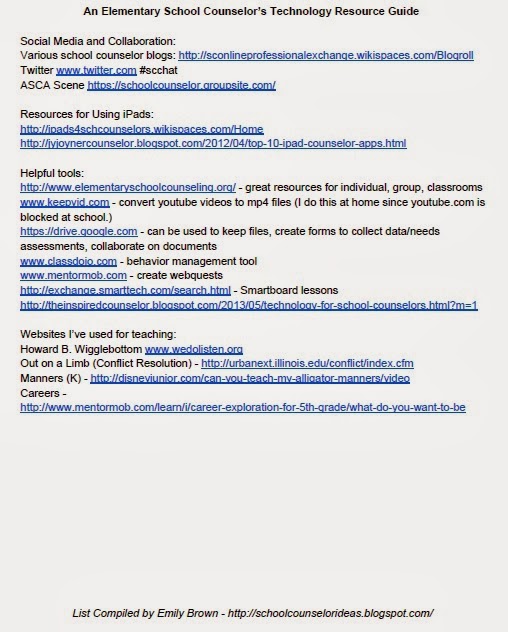
Clicking on the picture should take you to a copy of the technology guide.
Clicking on the picture should take you to a copy of the technology guide.
Wednesday, November 13, 2013
Listening.
I discuss listening quite frequently in my lessons. Whether I frame it as good listening, respectful listening, or active listening, the basic concepts of listening with our ears, eyes, and heart are covered.
In first grade (earlier this year) we read the book Listen Buddy by Helen Lester. This is one of my all-time favorite stories to read to students each year. After our discussion about what Buddy needed to do to improve his listening skills, I told the students I was going to test them to see how well they could listen. With some silly directions, students had to listen (and not ask questions) to follow my directions for how to color Buddy (I adapted this resource.)


In second grade, I read The Worst Day of My Life Ever! by Julia Cook. We discussed how much listening can affect how we feel and what happens to us. I reinforced the lesson with some of the resources found in the activity guide that accompanies the story. The listening game from this guide is great fun for the students (though still a bit complex for 2nd graders.) We will keep practicing this throughout the year!
Friday, November 8, 2013
7 Habits of Happy Kids - 1st Grade Style
After hearing a lot about Stephen Covey's 7 Habits of Happy Kids in the past year, I decided to give it a try. While there are school-wide curriculum resources through The Leader In Me website, I wasn't quite ready to purchase the whole curriculum. So I purchased two items that have enabled me to teach the content and found various other resources online that have reinforced my lessons. The students have really mastered the basic concepts of each habit. I used the book The 7 Habits of Happy Kids and I downloaded this awesome craftivity pack from Teacher's Pay Teachers. I did have to tweak some of the craftivities to simplify them for the sake of time and paper. But overall they have been a great reinforcement for what we've been learning.
Habit 1: Be Proactive

Habit 2: Begin with the End in Mind

Habit 3: Put First Things First

Habit 4: Think Win-Win

Habit 5: Seek First to Understand, Then Be Understood

Habit 6: Synergize

Habit 7: Sharpen The Saw

There are tons of other resources for 7 Habits available via Teachers Pay Teachers and Pinterest. I've also been teaching this to my 4th grade students and will have some follow up posts about what I've been using to teach them.
Friday, November 1, 2013
Anger Management Lessons
I've taught lessons on anger management to several grade levels over the past few weeks. I know it is vital that children learn that feeling angry is okay but you must not hurt yourself or others when you feel this way. Here are some of the ideas I've used in my teaching of these topics.
In Kindergarten we read the book Mouse Was Mad by Linda Urban. We practiced the standing still and deep breathing skills that Mouse uses as well as brainstormed some other things we could do when we're mad to control our anger. Students drew an angry face and colored a picture of a mouse. This is available for download here.

In third grade, I shook a bottle of soda and we talked about what would happen if we opened the bottle. We saw that if I slowly release a little fizz at a time, it would be safe to open. We connected this with our reading of Julia Cook's Soda Pop Head. We made a list of all the strategies Lester learns in the story to control his fizz. We practiced several of these strategies together.

In Kindergarten we read the book Mouse Was Mad by Linda Urban. We practiced the standing still and deep breathing skills that Mouse uses as well as brainstormed some other things we could do when we're mad to control our anger. Students drew an angry face and colored a picture of a mouse. This is available for download here.
In third grade, I shook a bottle of soda and we talked about what would happen if we opened the bottle. We saw that if I slowly release a little fizz at a time, it would be safe to open. We connected this with our reading of Julia Cook's Soda Pop Head. We made a list of all the strategies Lester learns in the story to control his fizz. We practiced several of these strategies together.
Tuesday, October 22, 2013
No, David!
In a Kindergarten lesson, we read three books by David Shannon: No, David!, David Goes to School, and David Gets in Trouble. As we read the books we identified the behaviors that were causing David to get in trouble and what better choices he could be making. After reading we identified characteristics and behaviors that would describe a Peacebreaker or a Peacemaker. I charted student responses on the board.


We made a David craft as a way to reinforce the story. These books are a great resource for discussing positive behaviors and expectations that lead to school success!
Sunday, October 20, 2013
Feelings Centers.
This year our school schedule has a unique Friday rotation to allow for vertical PLCs to meet. Because of this I have 3 55-minute classroom guidance rotations on Fridays outside of my usual every other week schedule, and I see these Friday classes every 6 weeks. I have been using these extra guidance times for "Fun Friday" so that these classes don't move ahead from their peers in my classroom guidance curriculum.
One of the things I've done so far with 3rd - 5th grade classes is centers, and these were a huge success! I loved being able to rotate around the room and observe the students learning and engaged, and the students were excited for a change of pace! This first rotation of centers focused on feelings. They were easy to put together and the students had a blast. Each rotation lasted about 10 minutes which was perfect for what I had planned. Here were the rotations I used:
1. Reading Center: I had a bucket full of books from my shelves about feelings, and students were invited to sit in my chair or lie on the carpet to read for a while.

2. iPad Center (definitely a favorite): I had access to 5 iPads so each child could use their own, and students explored the Feel Electric app. It has various games using feelings vocabulary. (I also researched how to set the iPads in guided access mode so students could not get out of this app.)

3. Poetry Center: I had students choose a feeling word to focus on and write a poem using a template I provided. They could then illustrate their poem and share it with others at their table.

4. Game Center: Students played Feelings Bingo and took turns being the caller of the feeling words for their group.

5. Art Center: I had this template of blank feeling faces for students to use to illustrate and label 12 different feelings.

I'm excited to try centers focused on other topics. I'm thinking bullying will be my next rotation to put together. Have you ever tried center rotations in your school counseling program?
Tuesday, October 8, 2013
Today I Feel . . .
Building a feelings vocabulary is an important part of my school counseling curriculum. In first grade we read Jamie Lee Curtis' Today I Feel Silly and made these feelings wheels.


After we finished, I called out a situation and students would point to it on their wheel. It was a great way for them to learn the vocabulary and connect feeling words within a context.
Subscribe to:
Posts (Atom)