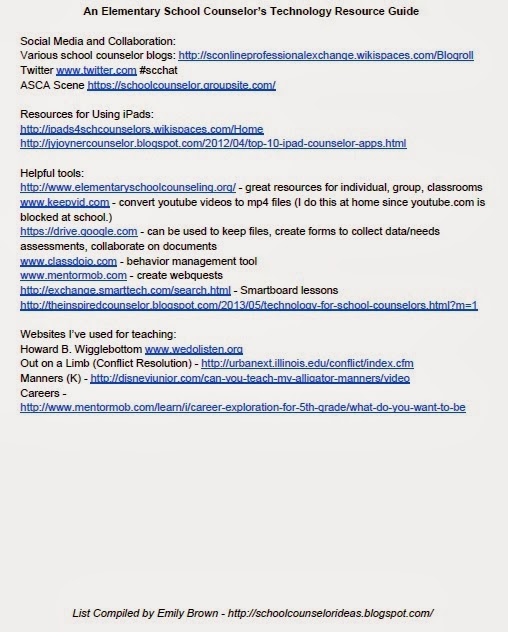
I hosted a PLC session for elementary counselors in my school district last week. I'm fortunate to have worked in schools that have invested in technology, and I use a Smartboard and computer and iPad daily at school. I know that not all school counselors have equal access to technology tools . But if you do, here are some links that I shared with my colleagues that may be of use to you as well!
Clicking on the picture should take you to a copy of the technology guide.
Welcome to my blog! My name is Emily Brown, and I'm a former elementary school counselor. I worked in elementary schools in North Carolina and Tennessee for 6 years before beginning a PhD program in Counselor Education at the University of Tennessee. I am passionate about the work of school counselors. This is a space where I share ideas from my work as well as things I'm learning in my studies. Connect with me via twitter (schoolcslrideas) or email me at schoolcounselorideas @ gmail.com.
Tuesday, November 19, 2013
Wednesday, November 13, 2013
Listening.
I discuss listening quite frequently in my lessons. Whether I frame it as good listening, respectful listening, or active listening, the basic concepts of listening with our ears, eyes, and heart are covered.
In first grade (earlier this year) we read the book Listen Buddy by Helen Lester. This is one of my all-time favorite stories to read to students each year. After our discussion about what Buddy needed to do to improve his listening skills, I told the students I was going to test them to see how well they could listen. With some silly directions, students had to listen (and not ask questions) to follow my directions for how to color Buddy (I adapted this resource.)
In second grade, I read The Worst Day of My Life Ever! by Julia Cook. We discussed how much listening can affect how we feel and what happens to us. I reinforced the lesson with some of the resources found in the activity guide that accompanies the story. The listening game from this guide is great fun for the students (though still a bit complex for 2nd graders.) We will keep practicing this throughout the year!
Friday, November 8, 2013
7 Habits of Happy Kids - 1st Grade Style
After hearing a lot about Stephen Covey's 7 Habits of Happy Kids in the past year, I decided to give it a try. While there are school-wide curriculum resources through The Leader In Me website, I wasn't quite ready to purchase the whole curriculum. So I purchased two items that have enabled me to teach the content and found various other resources online that have reinforced my lessons. The students have really mastered the basic concepts of each habit. I used the book The 7 Habits of Happy Kids and I downloaded this awesome craftivity pack from Teacher's Pay Teachers. I did have to tweak some of the craftivities to simplify them for the sake of time and paper. But overall they have been a great reinforcement for what we've been learning.
Habit 1: Be Proactive
There are tons of other resources for 7 Habits available via Teachers Pay Teachers and Pinterest. I've also been teaching this to my 4th grade students and will have some follow up posts about what I've been using to teach them.
Habit 1: Be Proactive
There are tons of other resources for 7 Habits available via Teachers Pay Teachers and Pinterest. I've also been teaching this to my 4th grade students and will have some follow up posts about what I've been using to teach them.
Friday, November 1, 2013
Anger Management Lessons
I've taught lessons on anger management to several grade levels over the past few weeks. I know it is vital that children learn that feeling angry is okay but you must not hurt yourself or others when you feel this way. Here are some of the ideas I've used in my teaching of these topics.
In Kindergarten we read the book Mouse Was Mad by Linda Urban. We practiced the standing still and deep breathing skills that Mouse uses as well as brainstormed some other things we could do when we're mad to control our anger. Students drew an angry face and colored a picture of a mouse. This is available for download here.
In third grade, I shook a bottle of soda and we talked about what would happen if we opened the bottle. We saw that if I slowly release a little fizz at a time, it would be safe to open. We connected this with our reading of Julia Cook's Soda Pop Head. We made a list of all the strategies Lester learns in the story to control his fizz. We practiced several of these strategies together.
In Kindergarten we read the book Mouse Was Mad by Linda Urban. We practiced the standing still and deep breathing skills that Mouse uses as well as brainstormed some other things we could do when we're mad to control our anger. Students drew an angry face and colored a picture of a mouse. This is available for download here.
In third grade, I shook a bottle of soda and we talked about what would happen if we opened the bottle. We saw that if I slowly release a little fizz at a time, it would be safe to open. We connected this with our reading of Julia Cook's Soda Pop Head. We made a list of all the strategies Lester learns in the story to control his fizz. We practiced several of these strategies together.
Tuesday, October 22, 2013
No, David!
In a Kindergarten lesson, we read three books by David Shannon: No, David!, David Goes to School, and David Gets in Trouble. As we read the books we identified the behaviors that were causing David to get in trouble and what better choices he could be making. After reading we identified characteristics and behaviors that would describe a Peacebreaker or a Peacemaker. I charted student responses on the board.
We made a David craft as a way to reinforce the story. These books are a great resource for discussing positive behaviors and expectations that lead to school success!
Sunday, October 20, 2013
Feelings Centers.
This year our school schedule has a unique Friday rotation to allow for vertical PLCs to meet. Because of this I have 3 55-minute classroom guidance rotations on Fridays outside of my usual every other week schedule, and I see these Friday classes every 6 weeks. I have been using these extra guidance times for "Fun Friday" so that these classes don't move ahead from their peers in my classroom guidance curriculum.
One of the things I've done so far with 3rd - 5th grade classes is centers, and these were a huge success! I loved being able to rotate around the room and observe the students learning and engaged, and the students were excited for a change of pace! This first rotation of centers focused on feelings. They were easy to put together and the students had a blast. Each rotation lasted about 10 minutes which was perfect for what I had planned. Here were the rotations I used:
1. Reading Center: I had a bucket full of books from my shelves about feelings, and students were invited to sit in my chair or lie on the carpet to read for a while.
2. iPad Center (definitely a favorite): I had access to 5 iPads so each child could use their own, and students explored the Feel Electric app. It has various games using feelings vocabulary. (I also researched how to set the iPads in guided access mode so students could not get out of this app.)
3. Poetry Center: I had students choose a feeling word to focus on and write a poem using a template I provided. They could then illustrate their poem and share it with others at their table.
4. Game Center: Students played Feelings Bingo and took turns being the caller of the feeling words for their group.
5. Art Center: I had this template of blank feeling faces for students to use to illustrate and label 12 different feelings.
One of the things I've done so far with 3rd - 5th grade classes is centers, and these were a huge success! I loved being able to rotate around the room and observe the students learning and engaged, and the students were excited for a change of pace! This first rotation of centers focused on feelings. They were easy to put together and the students had a blast. Each rotation lasted about 10 minutes which was perfect for what I had planned. Here were the rotations I used:
1. Reading Center: I had a bucket full of books from my shelves about feelings, and students were invited to sit in my chair or lie on the carpet to read for a while.
2. iPad Center (definitely a favorite): I had access to 5 iPads so each child could use their own, and students explored the Feel Electric app. It has various games using feelings vocabulary. (I also researched how to set the iPads in guided access mode so students could not get out of this app.)
3. Poetry Center: I had students choose a feeling word to focus on and write a poem using a template I provided. They could then illustrate their poem and share it with others at their table.
4. Game Center: Students played Feelings Bingo and took turns being the caller of the feeling words for their group.
5. Art Center: I had this template of blank feeling faces for students to use to illustrate and label 12 different feelings.
Tuesday, October 8, 2013
Today I Feel . . .
Building a feelings vocabulary is an important part of my school counseling curriculum. In first grade we read Jamie Lee Curtis' Today I Feel Silly and made these feelings wheels.
After we finished, I called out a situation and students would point to it on their wheel. It was a great way for them to learn the vocabulary and connect feeling words within a context.
Subscribe to:
Posts (Atom)