As we've been learning some ways to control our anger in 1st grade, we've talked about making good choices and cooling off first. To help students learn appropriate ways to talk to someone when they're having a problem, we learned about using "a bug and a wish." We role played various scenarios like this:
"It bugs me when you cut in line. I wish you would let me have my spot back."
"It bugs me when you take my pencil without asking. I wish you would give it back."
"It bugs me when you make fun of me. I wish you would stop."
Students were taught that the appropriate response is "Thank you for telling me. I will _____________." Hopefully this will fix the problem.
If the person they tell their bug and a wish to is not willing to cooperate, then they need to walk away or ask for help from an adult.
Students loved making bug and a wish talking sticks! They did a great job role playing with friends how they were going to use them.
Thursday, February 13, 2014


Monday, February 10, 2014
7 Habits in 4th Grade
This year we've learned about the 7 Habits during 4th Grade Guidance Lessons. I spent a week focusing on each habit and incorporated a discussion of the habit along with a video clip and a story each week. I pulled ideas from other resources and Pinterest boards but wanted to share my compilation of resources that I used to make it work for my program. I used habit descriptions found on the Leader in Me website.
 Habit 1: Be Proactive
After a discussion of what a habit is and some good habits we already have, we learned about what it means to be proactive and take initiative. We discussed the video clip below. We discussed the difference between proactive and reactive responses with a volunteer shaking a soda bottle or water bottle to illustrate our different responses. We read Salt in His Shoes and discussed ways Michael Jordan was proactive even when things like his height and what other kids said to him were outside of his circle of control.
Habit 2: Begin with the End in Mind
We discussed what this trait means and watched a Kid President pep talk clip. We used this video as a springboard to discuss what is meant by rocks and thorns - obstacles that try to keep us from reaching our goals. We spent time talking about how we can reach our goals. We read a Readers Theater about Nelson Mandela and his goal to end apartheid and how he didn't give up on his goal even when imprisoned for so long. Students completed an activity sheet outlining some of their personal goals and steps they could take to reach them.
Habit 3: Put First Things First
We discussed this habit and how we know what is the most important thing we need to accomplish. We talked about time management and how that helps us prioritize. We read Greatest Homework Excuse Book Ever and discussed how we sometimes use excuses rather than just getting our work finished. We watched a video clip about Rocks in a Jar and discussed why we have to put the big rocks (our priorities) in first. Students completed an activity sheet where they labeled rocks in a jar to indicate personal priorities and then identified other things that they can spend time on after those priorities are met.
Habit 4: Think Win-Win
We learned what it means to think win-win and the importance of working out conflicts. We discussed a situation and identified responses as win-win (both people win), win-lose (you win, but the relationship doesn't), or lose-win (you give in but feel like a doormat). We watched a video clip of the Pixar One Man Band and discussed the moments in this clip when we saw (almost) win-win, win-lose, or lose-lose behaviors. Students also completed an activity sheet with scenarios and they had to determine how it demonstrated a win-win solution.
Habit 5: Seek First to Understand, Then to Be Understood
With this habit we discussed ways to show we're trying to really listen to someone so they can listen to us. We talked about roadblocks to good listening - spacing out, pretend listening, selective listening, and selfish listening. We watched a video clip from Toy Story and discussed the poor listening skills seen from the other toys. We talked about how this habit is really about being able to look at things from various viewpoints as a way to understand others. We read parts of the book Pink and Say as an example of characters understanding someone who was different from them.
Habit 6: Synergize
We discussed what this habit means and why teamwork is important. We watched two video clips of synergizing and discussed ways we saw synergy and how it helped those in the video be successful. We read a Reader's Theater story of the Montgomery Bus Boycott which lead to a discussion of how synergy helped the Civil Rights leaders accomplish their goals. Students also wrote a letter to our principal identifying a problem they've observed at our school and ways they could use synergy to solve the problem.
Habit 7: Sharpen the Saw
After a review of the first 6 habits, we finished our discussion with what it means to sharpen the saw and have balance. We compiled a list of ways we sharpen our mind, heart, soul, and body. We watched a video clip from Soul Pancake and then identified activities shown in the video that could help you balance each part of your life. Students did an activity sheet where they identified personal ways they're working to have balance in each area of their lives. We finished our time watching Jannah Bolin's 7 Habits song which the students loved!
Friday, February 7, 2014
Keep Counseling.
Happy National School Counseling Week! I'm so proud to be a part of this profession dedicated to helping students succeed academically while supporting their social and emotional development. I received this note from a student at the holidays and thought this week was a perfect time to share. Little reminders that what you're doing makes a difference are needed some days!


Thursday, December 12, 2013
Christmas Career Lessons
Just in time for the holidays, I'm doing lessons in each grade level incorporating Christmas activities and a career focus. I have seen many of these ideas on other blogs and Pinterest, but here is how I've incorporated them! I love building upon the magic of the season.
Kindergarten: We read How Santa Got His Elves and applied to be Christmas elves! They were so excited to have elf finger prints (a non-toxic kid stamp pad!) One student told me he was going to leave his application out with the milk and cookies for Santa to see if he could get the job.

1st Grade: We read Snowmen at Work and illustrated our snowmen to fit with a career we'd want to have. Each student then displayed their snowman on the projector and had their friends guess what career it was - we talked about the tools and outfits to include as evidence for their chosen career.

2nd Grade: We read How Santa Got His Job and talked about strengths that help us be good at our job. Students filled out a Substitute Santa application.

3rd and 4th Grade: We had a discussion about how one finds a career and descriptive adjectives that we would want an employer to know about us if we were an applicant. We applied to be one of Santa's reindeer.

5th Grade: We talked about the job search process and students worked together to create a classified section of a newspaper looking for various Christmas jobs.
Kindergarten: We read How Santa Got His Elves and applied to be Christmas elves! They were so excited to have elf finger prints (a non-toxic kid stamp pad!) One student told me he was going to leave his application out with the milk and cookies for Santa to see if he could get the job.
1st Grade: We read Snowmen at Work and illustrated our snowmen to fit with a career we'd want to have. Each student then displayed their snowman on the projector and had their friends guess what career it was - we talked about the tools and outfits to include as evidence for their chosen career.
2nd Grade: We read How Santa Got His Job and talked about strengths that help us be good at our job. Students filled out a Substitute Santa application.

3rd and 4th Grade: We had a discussion about how one finds a career and descriptive adjectives that we would want an employer to know about us if we were an applicant. We applied to be one of Santa's reindeer.

5th Grade: We talked about the job search process and students worked together to create a classified section of a newspaper looking for various Christmas jobs.
Monday, December 2, 2013
A Wrinkled Heart
I think the image of a wrinkled heart is a powerful one to help students visualize the way our words affect others. In first grade this week we are learning about put-ups and put-downs. I read the story Bad Apple and discussed how Mac felt when the other apples were being mean to him. One of the things I like about this story is that we do not see the behavior of the other mean apples change in the book when Mac is different from them, but we do see Mac and Will supporting each other as friends in spite of the unkind words. So often students must decide how to handle the teasing when changing the mean kids is not in their circle of control. They are able to empathize with Mac in the story and relate to the feelings of sadness and loneliness he feels when being teased. I do want all students to be empowered to choose kind words and recognize the staying power of their words.
After our discussion, I wrinkled a heart each time a child told me something mean someone had said to them until it was a crumpled ball. I tried to smooth the heart back out with some of the nice things they say to each other. But we compared the heart with wrinkles to a smooth heart and discussed how we can never fully erase all of the mean words from our memory.

Students made a wrinkled heart craft as a take away from the lesson. They cut out the heart and put in some wrinkles since those mean words were on it. Then they wrote kind sayings on band-aids and glued them over the mean words. This activity is available for download here.


After our discussion, I wrinkled a heart each time a child told me something mean someone had said to them until it was a crumpled ball. I tried to smooth the heart back out with some of the nice things they say to each other. But we compared the heart with wrinkles to a smooth heart and discussed how we can never fully erase all of the mean words from our memory.

Students made a wrinkled heart craft as a take away from the lesson. They cut out the heart and put in some wrinkles since those mean words were on it. Then they wrote kind sayings on band-aids and glued them over the mean words. This activity is available for download here.


Kid President's video "20 Things We Should Say More Often" is a perfect end to this lesson!
Monday, November 25, 2013
The Thankful Book
With Thanksgiving later this week, we're spending some time in 1st grade learning about gratitude. Below is my lesson plan for this lesson. I loved this story as a way to help students brainstorm some of the things they are thankful for!
Activities:


And how sweet was this page that showed that one of my students was thankful for me! Warmed my heart today!!

Hook: When
someone does something nice for you, how do you let them know you appreciate
it? (saying thank you, hugs, smiles) How do you feel inside when someone does
something nice? (happy, thankful) With Thanksgiving later this week, we are
going to talk today about some of the
ways you show gratitude.
Activities:
- Read The Thankful Book by Todd Parr. Discussion – what might the author do when he feels thankful for all of these things? How would feeling thankful change his actions?
- Watch video trailer summary of book.
- Activity: Students will write and illustrate their own “The Thankful Book.”
- Students will read books to class as time allows.
And how sweet was this page that showed that one of my students was thankful for me! Warmed my heart today!!

Tuesday, November 19, 2013
Technology Guide for Counselors
I hosted a PLC session for elementary counselors in my school district last week. I'm fortunate to have worked in schools that have invested in technology, and I use a Smartboard and computer and iPad daily at school. I know that not all school counselors have equal access to technology tools . But if you do, here are some links that I shared with my colleagues that may be of use to you as well!
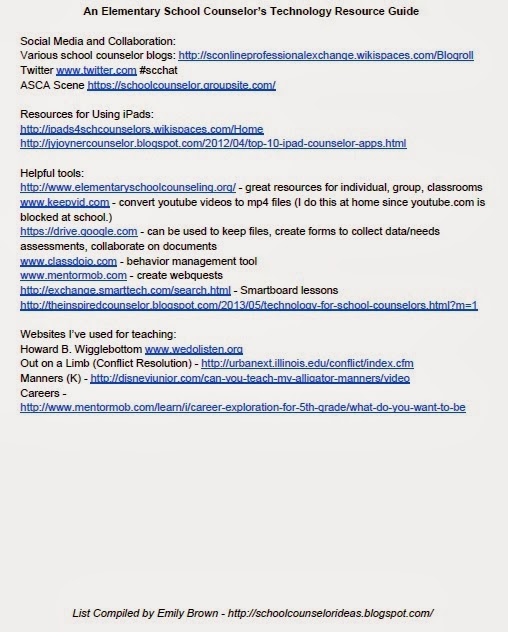
Clicking on the picture should take you to a copy of the technology guide.
Clicking on the picture should take you to a copy of the technology guide.
Subscribe to:
Posts (Atom)